




And other key sports marketing predictions for the year ahead
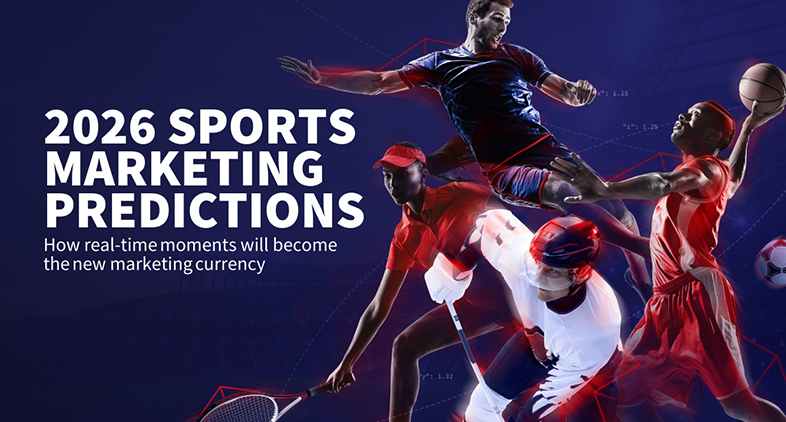
As live events continue to anchor global attention, the next competitive edge will come from activating moments at scale, using live data and AI to detect and activate key plays and emotions in real time. In 2026, marketing success will hinge on the ability to blend creativity with context, turning a single highlight or play into a multi-channel activation across social, digital, and broadcast environments. Brands that connect data and storytelling in the moment will own the fan’s attention, not just during the game, but throughout the entire sports calendar.
Sportradar is driving this evolution as the exclusive technology partner capable of enabling ownership of these moments at scale.
1. Curated sports supply is becoming the new normal; and the World Cup will accelerate it
The way brands buy sports media is quietly undergoing a shift. Instead of relying on broad, generic open-web inventory, more marketers are gravitating toward curated and context-rich environments where reach, quality, and relevance can be controlled with far greater precision.
The upcoming World Cup — the biggest in history — is pushing this even further. Many advertisers are already securing deal-based access to premium sports inventory, layering sports audiences onto open-web supply, and leaning more heavily on contextual signals like fixtures, rivalries, and form curves.
It doesn’t mean the open exchange goes away. It simply means that the center of gravity is moving toward supply paths where audience, context, and brand safety come together intentionally, rather than being left to chance.
2. Understanding fans is becoming a multi-source discipline; with first-party data as the anchor
Audience strategies in sports are also evolving. First-party data still offers the most reliable and permissioned view of a fan, but very few organizations have a complete first-party picture, and even those who do need additional context.
This is leading marketers toward a more blended, multi-source approach to fan understanding.
Content consumption, on-platform behavior, publisher insights, recent engagement signals, and live sports data are increasingly being combined to form a more accurate picture of what a fan cares about right now.
Recency matters more than ever. Campaigns that react to what fans just watched, just searched, or just engaged with, consistently outperform those built on static or seasonal segments.
The direction is clear: first-party data where available, enriched by fresh, contextual, multi-source fan signals that reflect the moment.
3. As sports become more chaotic, AI is evolving into the essential control layer for campaigns and creative
Sports marketing is getting harder, not easier. More matches, more leagues, more tentpole events, and more storylines unfold every day, and fan attention shifts in unpredictable pulses across platforms. Meanwhile, the media ecosystem grows more cluttered, and campaign operations spread across programmatic, social, search, and CTV.
This rising complexity is pushing AI into a new role. It’s no longer just something that optimizes a bid or a placement, it has become the critical system that keeps everything coordinated.
Teams are starting to rely on AI to anticipate fan behavior, rebalance budgets when attention spikes, keep campaign settings consistent, and stabilize pacing when the unexpected happens, which in sports is every day.
At the same time, creative production has undergone a dramatic leap forward. What once required studios and production cycles can now be created in minutes and matched to the emotional state of fans in the moment. As the sports ecosystem becomes more complex, AI becomes the practical way to stay in control and stay relevant; this direction is unmistakable.
4. Paid social and paid search are becoming more reactive to the rhythm of live sports
Sports are inherently real-time, and paid media is slowly learning to behave the same way.
More brands are using search and social not just as channels for reach, but as intent and reaction layers: adjusting bids, messages, and spend when live sports moments shift fan attention.
Creative in social is increasingly aligned to emotional states like anticipation before kickoff, tension during close matches, or celebration after a win. Search campaigns are activated or intensified when spikes in intent appear, often tied directly to moments on the pitch or court. It’s still early, but the direction is visible: paid channels are becoming more reactive, more moment-sensitive, and more aligned with the actual rhythm of sports.
5. Creative is shifting toward fan-state personalization
For years, sports campaigns relied on static creative templates. That era is fading.
Creative strategies are slowly shifting toward fan-state personalization, a more fluid approach where ads reflect not only who a fan is, but also how they feel in the moment. Messaging is starting to adapt to game flow, rivalry intensity, star-player narratives, or even the mood of a home crowd after a tough loss.
Not every campaign is dynamic yet, but the appetite and the tooling are clearly moving in that direction. Over time, campaigns that mirror fan emotions will simply perform better than those that ignore it.
6. Measurement is beginning to organize around moments, not channels
Measurement in sports advertising has long been fragmented by channel. As budgets stretch across programmatic, CTV, social, and search, the industry is slowly moving toward more holistic, moment-aware measurement, frameworks that reflect the fan’s full journey rather than the siloed performance of individual placements.
There is growing focus on attention metrics, lift, and unified dashboards. Some organizations are already experimenting with moment-level attribution, understanding how a specific play, goal, upset, or milestone influenced outcomes across the entire media mix. This isn’t fully standardized yet, but the direction is clear: meaningful measurement in sports will revolve around the moments that matter, not the channels that delivered them.
Get ahead of the game with Sportradar Marketing Services
Sportradar is the definitive sports marketing technology partner, connecting advertisers to every key moment that matters to modern sports fans.
As sports marketing accelerates into 2026, one truth is unmistakable: winning brands will be those that show up in the moments that matter most to fans: when emotion, attention, and intent converge in real-time. Doing so demands a tightly integrated foundation built on speed, accuracy, and intelligence.
At the center of this evolution is trusted, official sports data. Decades-long partnerships with leagues, federations, and broadcasters unlock live, high-fidelity signals at massive scale, fueling the timeliness and relevance that modern sports fans now expect. When that data is seamlessly integrated into our proprietary sports-trained demand-side platform, and instantaneous Dynamic Creative optimization, brands gain an unrivaled ability to detect moments as they happen and activate instantly, across channels.
In 2026, competitive advantage will belong to marketers who think holistically, who understand that sport data, dynamic creative, and activation technology are not standalone tools, but a single engine for real-time engagement. Those who invest in this connected ecosystem won’t just react to the biggest sports moments. They’ll own them.